
Vision Therapy for Anisometropia
What is Anisometropia?
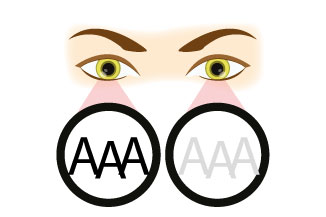
Anisometropia is a condition in which the eyes have significantly different refractive power: One eye sees very well while the other doesn’t. This discrepancy causes the brain to receive two very different images, resulting in eye strain, squinting and headaches. Anisometropia can lead to a serious condition, amblyopia, also known as “lazy eye” that causes the brain to compensate for the imbalance by essentially ignoring one eye and seeing solely with the other eye.
When the brain ignores one eye, communication between that eye and the brain becomes much weaker — a problem that should be addressed immediately by contacting Dr. Priya Maharaj.
Anisometropia can result from:
- A large difference in the optical prescription between the two eyes
- Strabismus, with the eyes not aligning properly
- Accommodation difficulties, with one eye doing more of the focusing
- Ptosis, when the upper eyelid droops and blocks vision
- Diseases affecting the eyes or surrounding ocular structures
- Detached retina
This condition also can occur when the eyes are not the same size, shape, or curvature. As a result, when a person looks at an object, each eye perceives the object with significant differences, causing visual disturbances such as blurry or double vision.
What Can be Done About Anisometropia?
If the visual acuity difference between the two eyes vary widely, this may not be fully correctable with eyeglasses. However, contact lenses may prove to be more effective as they sit directly on the eyes, providing a more comfortable solution. LASIK surgery may also be an option.
During childhood, anisometropia can be successfully addressed through vision therapy, which is a personalized program of exercises managed by Dr. Priya Maharaj. Vision therapy for children with anisometropia might include the following:
- Customized exercises to stimulate the brain’s connection with the weaker eye
- Wearing a patch over the favored eye so the child has no choice but to see with the weaker eye
- Wearing glasses with prism lenses while reading, in school, doing homework, watching TV, or playing video games
- Eye drops that temporarily blur the favored eye, leaving the child no option but to use on the weaker eye.
References:
- https://www.ncbi.nlm.nih.gov/pmc/articles/PMC3755309/
- https://www.seevividly.com/info/Lazy_Eye/Amblyopia/Anisometropia
- https://www.sciencedirect.com/topics/medicine-and-dentistry/anisometropia